QuARUm
Quality Assessment of Analytical Data in Resource and Environmental Research
Project Description
The volume of published geochemical data, the quantity of biogeochemical databases, and the number of entries continually rise. However, assessing the quality of literature data is often challenging or even impossible due to a lack of essential background information. Therefore, the aim of the QuARUm project is to develop methods and a software tool that assists researchers in evaluating the quality of biogeochemical analysis data.
The project is a collaboration between the research groups CritMET - Critical Metals for Enabling Technologies at Constructor University (formerly Jacobs University Bremen) and Software Engineering at Technical University of Dortmund to jointly develop a low-code software tool that objectively evaluates the quality of biogeochemical data using fully modifiable, sample-specific criteria. This evaluation should be applicable to self-measured analytical data, literature data, and large geochemical databases. The software tool is designed as an open-box environment and is completely modifiable based on the respective applications and user needs. To ensure ease of use even without in-depth programming knowledge, a domain-specific language (DSL) will be developed through user feedback loops that is intuitive and easy to learn for the target group (BioGeochemistry). A high degree of user-friendliness of the software tool is a crucial factor for the success of the research project.
Funding Information
QuARUm is a collaboration with TU Dortmund and is funded by the BMBF (link to BMBF webpage).


Project Diary
2024
This is the first entry and thus a summary of the past one and a half years within QuARUm .
We developed GeoArmadillo, a software tool to build data processing pipelines in an intuitive drag-and-drop interface. GeoArmadillo is based on Google Blockly and automatically transforms the built data processing piplines into executable Python code. We have recently submitted a manuscript that describes the design and usage of GeoArmadillo. Furthermore, we plan to fully publish GeoArmadillo this year .
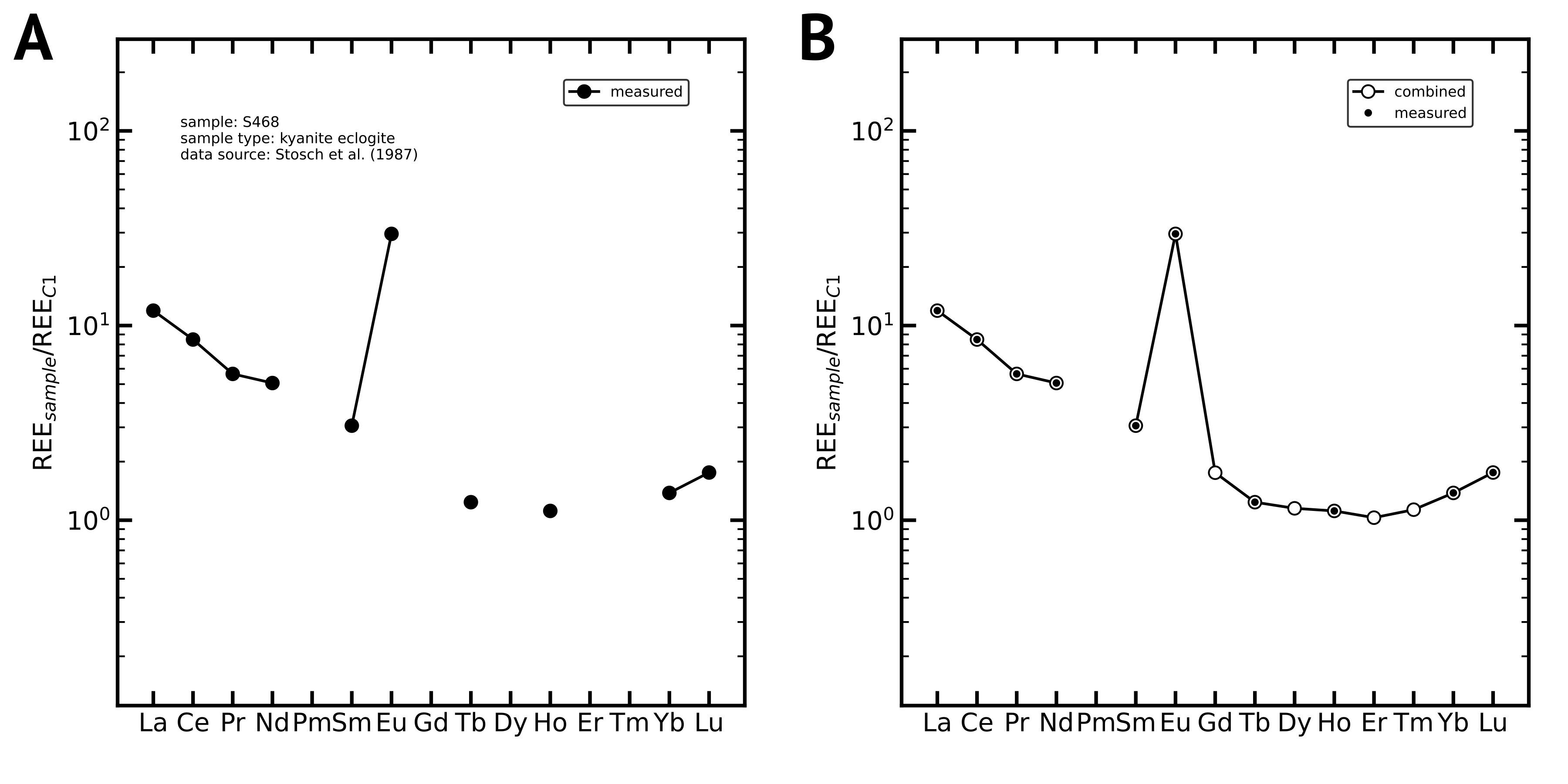
We developed a method that reliably filters suspicious rare earth element data in datasets of any size. This method is based on the general concept of coherent geochemical behavior among the rare earth elements. With this method, researcher can objectively assess the usability of their analytical data and published data. Furthermore, the same approach can be used to compute missing rare earth element data. An example on how missing rare earth element data is "restored" can be seen in the figure below. The left plot shows the original data, that misses data for gadolinium (Gd), dysprosium (Dy), erbium (Er), and thulium (Tm). The right plot shows the same sample after the missing data was computed.
The first manuscript we submitted on this method is currently in the final review stage. We will submit another manuscript soon.